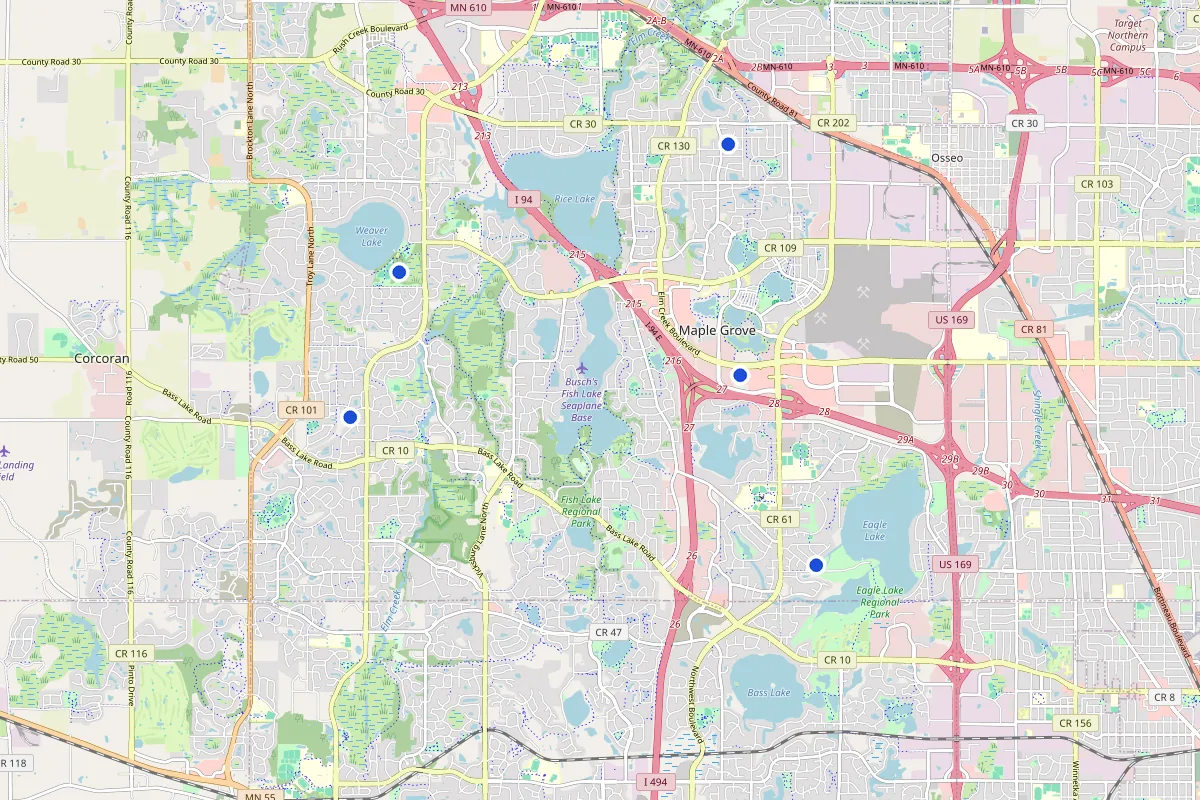
Most people arrive at this question the same way: they have a spot in the yard, they have a sport in mind, and every number they can find online is either a national average or a figure with no Minnesota in it. This page is the honest version. It covers what actually drives the number on a Maple Grove bid, four local rules that change a quote before anyone pours concrete, and how to read two quotes side by side without guessing.
One thing up front, because it shapes everything below. This site is run by Wayfind Local Group, and we do not build courts. We connect Maple Grove homeowners with a local court builder, and the builder prices the job, not us. Nothing on this page is a quote, an estimate for your lot, or a figure anybody has agreed to charge you. See our vendor disclosure for exactly how that works and how we are paid.
What the published numbers actually say, and why they cannot answer your question
There is no shortage of cost figures for backyard courts online. The problem is that they disagree with each other by a very large margin, and almost none of them price a northern-climate build.
Published national estimate, quoted here as a market reference and not as anyone's quote. Sports Venue Calculator's 2026 range for building a pickleball court is $20,000 to $150,000 in total, and inside that total it lists fencing separately at $4,000 to $7,200.
A band that wide is not a price. It stretches from a tile surface dropped onto a slab that already exists all the way to a lit, fenced, tournament-spec build, and it prices no Minnesota site work whatsoever.
We do not set this price and we never collect it. The builder you hire quotes your job in writing after standing in your yard.
The single biggest line item is usually the thing under the court rather than the court itself.
Published national average for the slab alone. VersaCourt, a court-surface manufacturer, puts a concrete slab built to general specifications at roughly $4 to $10 per square foot nationally. On the same page it states that this figure excludes site prep and that bids vary by region.
In Maple Grove the excluded half is the half that moves. Site prep is where a flat, well-drained lot and a wet, sloped one stop resembling each other.
We do not set this price. The provider quotes your job in writing.
So treat any national figure as a sanity check on the order of magnitude and nothing more. What follows is what moves you inside the band.
What actually drives the price of a backyard court
A court quote is not one number. It is a stack, and each layer can be specified up or down independently. These are the variables that move a Maple Grove bid the most, roughly in order of how much they swing it.
| Driver | Why it moves the number |
|---|---|
| Court footprint | Every layer is priced by area. A regulation pickleball court with safety run-out is a much larger slab than a half-court basketball pad, and a multi-sport court sized for two uses is larger again. Footprint multiplies base, surface and fence all at once. |
| Site prep and excavation | Cutting a level pad into a sloped yard means moving material, and moving material off site costs more than balancing the cut and fill on site. Tree removal, buried utilities and poor access for equipment all sit here. |
| Drainage and sub-base | The aggregate base under the slab is what keeps a Minnesota court flat through freeze and thaw. Thicker base, geotextile fabric, and a drain tile run are common on wet lots and are not optional there. |
| Slab vs existing surface | Laying a modular tile system over a sound slab you already own removes the largest single cost in the project. Pouring new removes that saving. |
| Surface system | Acrylic color coat over concrete, modular polypropylene tile, and post-tensioned slab construction are three different products at three different prices with three different repair stories. |
| Fencing height and length | Fence is priced per linear foot and scales with height. As the local rules below explain, height is where Maple Grove specifically gets expensive. |
| Lighting | Poles, fixtures, conduit, trenching and sometimes a panel upgrade. Lighting is frequently the line that gets cut when a bid comes back high, and it is the easiest to add later if the conduit is run during the build. |
| Nets, hoops and accessories | Permanent net posts set in ground sleeves, adjustable hoop systems, ball containment netting. Smaller money, but they vary a lot by brand. |
| Season and lead time | Minnesota court work runs roughly April through October. A job that has to be squeezed into the end of a season, or held over winter, is priced differently than one booked with room around it. |
Four Maple Grove rules that change a bid before anyone pours concrete
This is the part national cost guides cannot give you. Each of these is checkable, and each one can change a quote materially. Verify them against the current code yourself, or ask your builder to show you where they land on your lot.
1. Your court counts against a 40 percent impervious surface cap. Maple Grove City Code section 36-787 sets the maximum impervious surface for each lot in the R-1, R-2 and R-3 residential districts at 40 percent. A court slab is a large piece of impervious surface, and it lands on top of the house, garage, driveway and patio you already have. If the new court pushes the lot over the cap, the fix is a design change: a smaller footprint, a permeable material somewhere else on the property, or a stormwater feature. All three cost money, and a builder who checks this before bidding is telling you something useful about how they work. (Source: Maple Grove Code of Ordinances, Chapter 36 Zoning, section 36-787, read 2026-09-11.)
2. The 6 foot residential fence limit is the one that surprises people. Court fencing is commonly specified at 10 feet to keep balls in. In Maple Grove, the Building Department’s own Fences handout (revision 4/14/2021) states that in residential areas fences no more than 6 feet in height may be erected, while building permits are not required for fences that do not exceed 7 feet. Those are two different rules doing two different jobs: the permit threshold is a building-code question and the 6 foot limit is a zoning question, and the zoning limit is the one that governs what you may build. A taller court fence is not a catalogue item you simply order. The handout notes that fences differing in height may be permitted by conditional use permit, which means an application, a review, and a timeline. Ask any bidder whether their fence line assumes a conditional use permit and who is responsible for filing it. (Source: City of Maple Grove Building Department, “Fences,” rev. 4/14/2021, read 2026-09-11.)
3. Near water, the fence rules tighten again. The same handout states that fences located within any portion of the 75 foot lakeshore setback area shall not exceed 5 feet in height, must maintain see-through visibility equal to that of a chain link type fence, and must be treated in browns to greens to blend with the natural surroundings. Maple Grove has a lot of shoreline. If your lot sits near Weaver Lake, Eagle Lake, Fish Lake or Rush Creek, a bid that quotes a standard court fence without mentioning the setback has probably not looked. There is also a corner-lot rule worth knowing: no fence within the triangular sight area measured 30 feet along each of two intersecting street property lines. (Same source, read 2026-09-11.)
4. A court build almost certainly requires a licensed residential building contractor. Minnesota Statutes section 326B.802 defines a residential building contractor as someone who contracts with an owner to build residential real estate by providing two or more special skills, and the statute enumerates eight of them, including excavation and masonry and concrete. A backyard court that involves site work and a poured slab has already touched two. That makes the licence a legal requirement rather than a nice-to-have credential, and it is verifiable in a few seconds through the Minnesota Department of Labor and Industry at dli.mn.gov. Ask for the licence number, then look it up yourself rather than accepting a photo of a card. (Source: Minn. Stat. 326B.802, read 2026-09-11.)
One rule that works in your favour: Maple Grove’s zoning code at section 36-788(d) excludes tennis courts from the definition of accessory buildings, so a court does not eat into the accessory-building allowance that governs sheds and detached garages. That is a narrower carve-out than it first looks, so confirm how it is applied to the specific sport you are building for.
And one that is not the city’s problem at all. The Fences handout says plainly that protective covenants on a lot might have different location and design requirements, that covenants are not enforced by the City of Maple Grove, and that you should contact your homeowners association about rules specific to your property. A court can be fully compliant with city code and still be refused by an HOA architectural review committee. In the newer Maple Grove subdivisions, the HOA process is often the longer of the two timelines. Ask for the review calendar early, because a missed monthly meeting can push a build past the end of the season.
What a legitimate written quote includes
A quote you can actually compare is specific about scope. A quote that is one number and a sentence is not a bid, it is a placeholder. At minimum, look for these spelled out in writing:
- Dimensions of the playing surface and of the slab, which are two different numbers once run-out space is included.
- Excavation scope, including whether spoil is hauled off site or balanced on the property, and what happens if rock or unsuitable soil is found.
- Sub-base specification: material, compacted depth, and whether geotextile fabric or drain tile is included.
- Slab specification: thickness, reinforcement, control joint layout, and the concrete mix.
- Surface system by product name, colour, and the line-marking standard being used for your sport.
- Fence by height, material, gate count, and, given the rules above, whether a conditional use permit is assumed.
- Lighting, or an explicit note that conduit is or is not being stubbed for a future lighting package.
- Who files what: zoning application, any conditional use permit, HOA architectural submission, and who pays the fees.
- Warranty, separated into workmanship and manufacturer surface warranty, with durations for each.
- Payment schedule tied to milestones rather than to dates.
- Licence and insurance: the Minnesota licence number, plus a current certificate of insurance sent from the insurer rather than forwarded as an image.
If you are asked to sign anything you do not follow, have a Minnesota attorney read it. We are not lawyers and this page is not legal advice.
How to compare two quotes in Maple Grove without guessing
Two bids that differ a lot are usually not bidding the same job. Before you conclude one is expensive, line them up on these:
- Normalise the footprint first. Convert both to the same slab area. A bid that looks cheaper often is, because it is smaller.
- Compare sub-base depth, not slab thickness. In a freeze-thaw climate, the base is what determines whether the court is still flat in year ten. A thinner base is the most invisible way to make a bid cheaper.
- Find the drainage line. If one bid carries drain tile and the other does not, ask the second one why. There may be a good answer. There may be no answer.
- Check what is excluded. Exclusions are where the difference usually lives. Tree removal, retaining walls, irrigation relocation, sod repair and equipment access damage are common ones.
- Read the fence line against the rules above. A 10 foot fence quoted with no mention of a conditional use permit is either an oversight or a cost that is about to appear.
- Look for allowances. An allowance is a placeholder number, not a price. Several allowances in one bid means the final figure is not yet known.
- Ask both for two completed Maple Grove area references and call them. Ask specifically about change orders and about how the court came through its first spring.
What the court costs after it is built
The install quote is not the whole cost of ownership, and the ongoing side is where surface choice pays you back or does not.
- Resurfacing. Acrylic color coat over concrete is a wearing surface and is expected to be recoated on a cycle. Modular tile is replaced by the tile rather than recoated. Ask for the expected cycle in writing and treat it as part of the decision.
- Crack repair. Concrete in Minnesota moves. Control joints are designed to decide where it cracks. Ask what the warranty says about cracking, because “cracks are normal” and “cracks are covered” are very different sentences.
- Snow and ice. Ask what the surface manufacturer permits for winter clearing. Steel blades and de-icing chemicals damage some systems and void some warranties.
- Nets and hardware. Net systems, hoop hardware and containment netting are consumables on a long cycle, especially outdoors here.
- Lighting. Fixtures, and eventually the electricity. If the court is lit for evening play most of the season, that is a real recurring line.
- Property tax and insurance. A permanent improvement can affect your assessment and is worth a call to your insurer so the structure is actually covered.
Frequently asked questions about backyard court costs in Maple Grove
Is a tile court over an existing slab really much cheaper? It removes the largest cost in the project, which is the new slab and the site work beneath it. The catch is that the existing slab has to be sound, flat within tolerance, and correctly drained. An old patio that is cracked or pitched the wrong way is not a shortcut. Have it assessed before you plan around it.
Does a smaller court save proportionally? No. Costs that scale with area do fall, but mobilisation, survey, permitting, HOA submission and equipment transport are close to fixed. Halving the size does not halve the bid.
When should I be getting quotes? Earlier than feels necessary. The Minnesota build window runs roughly April through October, and the sequence ahead of a build is survey, then design, then HOA architectural review, then any city application. Any one of those can take weeks. Homeowners who start in late winter are choosing between bids. Homeowners who start in June are often choosing between next season and a rushed job.
Can I phase the project? Often yes, and it is usually the sensible answer when a bid comes back above what you had in mind. Base, slab and surface are one phase. Fencing and lighting can follow. The one thing worth paying for during the first phase is conduit, because trenching a finished court is expensive.
Will you tell me what my court will cost? No, and we would be making it up if we did. We do not build courts and we do not set anyone’s price. What we do is connect you with a local builder who will survey your lot and put a written quote in front of you. The rules and the drivers on this page are here so that when that quote arrives you can read it properly.
Getting a real number for your lot
A number that means anything comes from someone standing in your yard with a tape measure and a level, looking at your slope, your drainage, your access and your setbacks. Tell us the sport, roughly where in Maple Grove you are, and any constraint you already know about, and we will pass it to a local builder. We are a referral service, we do not do the work, and we never bill you. The vendor disclosure page sets out the whole arrangement.
Sources used on this page, all read 2026-09-11: Maple Grove Code of Ordinances, Chapter 36 Zoning (sections 36-787 and 36-788(d)); City of Maple Grove Building Department, “Fences,” rev. 4/14/2021; Minn. Stat. 326B.802; Minnesota Department of Labor and Industry. Cost references are cited and dated in the two attributed blocks above.