Backyard batting cages in Maple Grove, MN are single-lane setups for baseball and softball volume practice, sized to the player and the yard, across Maple Grove and the northwest Twin Cities suburbs. If there’s a serious hitter in the house and you’re ready to stop driving to an indoor facility for reps, this page covers cage length and width, frame and netting choices, the optional turf and pitching mound, HOA review, and the April-through-October Minnesota install season.
What batting cage installation in Maple Grove, MN typically looks like
Backyard batting cages are a narrower niche than courts — the typical Maple Grove household commissioning one has a serious player in residence. HS varsity, travel-ball, or a college recruit working fall-and-winter reps without a 25-minute drive to the nearest indoor facility. The use case is volume practice: tee, soft-toss, front-toss, machine, and live-arm work.
Single-lane cages go in across Maple Grove ZIPs 55311 and 55369, most often along a side yard or back property line where 50–70 feet of straight run is available. The MN install window runs April through October. Once up, the cage runs March-through-November practice; most owners pull the net for hard-winter months (December–February) to extend net life.
Maple Grove’s baseball + softball scene
There’s a real reason backyard cages come up in Maple Grove. The Osseo-Maple Grove Athletic Association fields youth baseball and softball teams from roughly 8U through 19U, and the city’s turf ball complex — Gleason Fields (18815 67th Avenue North) — runs four FieldTurf fields under Musco LED lighting with six batting cages of its own (per the City of Maple Grove parks pages and the Osseo-Maple Grove Athletic Association). The families who book those public cages between practices are exactly who calls us: a travel-ball or varsity hitter who wants unlimited reps at home instead of a 25-minute drive and a reserved time slot.
A backyard cage in Maple Grove is the home version of the volume work serious players already put in around town. The sizing, frame, and netting decisions below are what shape the build.
Backyard cage vs. driving to a facility
Most Maple Grove families weighing a backyard cage are already paying for reps somewhere else — the six public cages at Gleason Fields between team practices, or a paid indoor hitting facility 20–25 minutes away with reserved time slots. A backyard cage changes the math in a few ways worth thinking through before you build:
- Reps on your schedule. No reservation, no drive, no shared time slot. A hitter can take 100 swings before school or after dinner without anyone loading the car. For a household with a serious player, that convenience is usually the whole reason the cage gets built.
- Season. A backyard cage runs roughly March through November in Minnesota, with the net pulled for the December–February hard-winter stretch. An indoor facility is the year-round option — so some families run a backyard cage in season and keep a winter facility membership for January and February. The two aren’t mutually exclusive.
- Setup vs. variety. A facility offers multiple machines, lanes, and sometimes coaching. A backyard cage is sized and equipped to one hitter’s needs — an advantage for focused volume work, a limitation if you want machine variety. Matching the machine and netting to the player (see the netting and mound sections below) is how a backyard cage closes most of that gap.
If the player is putting in enough volume that the drive and the reserved slots are the bottleneck, a backyard cage usually pays its convenience back quickly. If they hit a few times a month, the public cages plus a facility membership may be the better fit — and that is worth saying out loud on the survey call.
What’s included
- Site survey: measure available run, check slope and drainage, flag setback and HOA constraints
- Layout drawings for HOA architectural-review submission
- Base prep: ground leveling and post-footing pad work
- Galvanized-steel pole frame assembly and anchoring (cable-suspended and enclosed-building on request)
- Netting: #36 or #42 HDPE/poly net hang and tensioning
- Optional turf flooring with shock pad
- Optional pitching mound — portable rubber or built-in dirt + rubber
- Walkthrough with care-and-maintenance instructions
How pricing works
What a backyard batting cage costs in Maple Grove depends on cage length, frame system, netting weight, and add-ons like turf flooring and a pitching mound. We are not the installer and we don’t set the price — the installer quotes your build in writing after a site survey.
What moves the number:
- Length. A 40-foot light-practice cage is the smallest common build; a 70-foot full-distance HS+ cage is the largest.
- Frame system. Galvanized-steel pole frame is the workhorse; cable-suspended adds cost.
- Netting weight. #36 HDPE for backyard baseball and softball volume; #42 for higher-velocity machine work or college-level arms.
Every quote is written by the installer, after a site survey.
Sizing: single-lane lengths and width
Single-lane cages are typically 12–14 feet wide (softball-spec slightly wider). Length tracks the player’s level:
- 40 feet — Tee, soft-toss, front-toss, short-distance machine work. Good for younger players or limited yard run; no full-distance live pitching.
- 55 feet — Travel-ball pitching distance (46–50-foot mound plus runout). Most common Maple Grove backyard build.
- 70 feet — Full HS+ pitching distance (60.5-foot mound plus runout). For varsity and college recruits; requires a longer, straighter yard.
A 70-foot cage at 14-foot width and 12-foot height needs about a 75 × 15 footprint with net clearance on all sides.
Frame systems: pole vs cable vs enclosed
- Galvanized-steel pole frame — the standard backyard build. Vertical poles every ~10 feet, anchored in concrete-footing pads. Most cost-efficient.
- Cable-suspended — net hangs from a tensioned cable anchored to end-posts or existing structures. Cleaner sightlines; engineering is more demanding and adds cost.
- Enclosed building-frame — pole-barn or steel-frame structure with a cage inside. Year-round MN use.
Most Maple Grove backyards land on the galvanized-steel pole frame for the cost-to-durability ratio.
Netting: gauge, material, and knot type
Netting is the part of a backyard cage that wears first, so the gauge and material decision is worth getting right up front. Two specs drive it: twine gauge (the #-number) and the material/knot construction.
- Gauge — #36 vs #42. The #-number is net twine thickness; higher is heavier. #36 is the standard for backyard baseball and softball volume work at tee, soft-toss, front-toss, and most machine speeds. #42 is the step up for higher-velocity machine work (roughly 70+ mph) or college-level live arms, where the extra mass absorbs harder contact and lasts longer. A 70-foot full-distance cage for a varsity or recruit hitter is the typical #42 candidate — the kind of build that fits the larger lots in corridors like Rush Creek; a 40–55-foot cage for a younger or travel-ball player is usually fine on #36 (consistent with the CageList 2025 and LFS Sport Nets specs cited above).
- Material — HDPE/poly vs nylon. Knotless HDPE/poly net is the common outdoor choice in Minnesota: it’s UV-resistant, doesn’t absorb water, dries fast after a storm, and costs less. Nylon (usually knotted) is more abrasion-resistant with a slightly softer hand, but it absorbs moisture and degrades faster in sun unless treated — a meaningful trade-off for an outdoor cage that sees MN sun April through October.
- Knot type. Knotted net is more durable at the intersections and easier to repair panel-by-panel; knotless is lighter, smoother, and less likely to mark a ball. For a backyard cage that gets pulled and re-hung seasonally, either works — the bigger longevity lever is pulling the net for the December–February hard-winter months, which roughly doubles its life (see the netting question below).
The gauge is spec’d to the hitter’s level and the material to outdoor MN conditions, and the choice is written into the quote so you know exactly what’s hanging in the yard.
Pitching mounds: portable vs built-in
- Portable rubber — molded unit sized for Little League, travel, or HS distances. Moves off the cage floor for tee or machine work; stores in a garage for winter. The default for most backyard cages.
- Built-in dirt + rubber — graded mound with clay or composite surface and embedded pitching rubber. Closer to a true game-mound feel; cannot be moved.
For dedicated pitchers, built-in is usually worth the upgrade. For hitters using the cage mostly for batting reps, portable is the right call.
Turf, hitting mats, and base prep
The floor of a backyard cage runs from bare graded ground at the low end to full synthetic turf at the high end, and most Maple Grove builds land somewhere in between:
- Natural graded ground. Lowest cost — the cage sits on leveled, well-drained grass or dirt. Workable if you want the simplest possible setup, but the hitting area wears to dirt fast and turns muddy in spring and after rain, a real consideration on Maple Grove’s clay-heavy soils.
- Hitting-zone mat. A turf or rubber mat under the plate and pitching lane only, over graded ground elsewhere. A common middle path — it protects the high-wear zone and gives consistent footing without the cost of flooring the whole cage.
- Best drainage, cleanest year-to-year wear, and the closest feel to an indoor facility floor; the shock pad also takes some load off knees and ankles during long sessions.
Drainage matters more here than in warmer states. Maple Grove’s clay soils hold water, so the build grades for runoff and, on full-turf builds, sets a drainage base under the pad — otherwise spring melt and summer storms pool under the hitting zone. Base prep is quoted after the site survey checks slope and soil.
Maple Grove HOA considerations
Many Maple Grove subdivisions require architectural-review-board approval for backyard structures, but batting cages typically clear HOA review more easily than full courts — smaller footprint, no concrete pad in most builds, and a lower sound profile (no acrylic-court “pop”). Boards commonly want a scaled layout, the frame and netting materials, and a screening plan. Your board will tell you what its packet requires, and the installer who takes the job prepares what they need for it.
Process and lead time
- Site survey. Measure available run, check slope and drainage, confirm sight-line and screening.
- Written quote. Ask the installer to spell out length, frame, netting weight, turf, and mound choices line by line.
- HOA documentation where applicable — dimensioned drawings and screening plan for ARB submission.
- Schedule the build. Most Maple Grove cage projects run 1–3 months call-to-completion — faster than court builds (no concrete pad or acrylic-surface curing).
- Install. Pole-frame cages typically install in 1–2 days after footing-pad cure; turf and mound add a day; net hang is the final step.
- Walkthrough. Care-and-maintenance instructions, net-storage guidance, warranty paperwork.
Where a cage can sit in Maple Grove, and the noise number to check
Two rules shape a backyard cage more than any product choice does, and both are worth settling before the survey rather than after the frame is up.
Side yard placement is a question for the city, not an assumption. Maple Grove City Code section 36-788(b) states that, farm buildings aside, no accessory buildings shall be erected or located within any front yard or any required yard other than the rear yard. Section 36-788(d) then excludes a short list from the accessory-building definition: unenclosed playhouses and gazebos, uncovered swimming pools, detached decks or patios, and tennis courts. A batting cage is not on that list. Cages usually go along a side yard because that is where the straight run is, so whether a pole frame and netting is treated as an accessory building on your parcel is exactly the thing to confirm with Maple Grove Community Development at 763-494-6040 before a layout is drawn. Finding out after the posts are set is the expensive version of that call. (Source: Maple Grove Code of Ordinances, Chapter 36 Zoning, section 36-788, read 2026-05-28.)
Neighbor noise has an actual number attached to it. Minnesota Rules part 7030.0040 sets state noise standards by area classification, and household units sit in noise area classification 1. The limits there are 60 dBA L50 and 65 dBA L10 by day, and 50 dBA L50 and 55 dBA L10 at night, where L50 is the level exceeded half the time and L10 is the level exceeded a tenth of the time. Two things follow for a cage. The night figures are ten decibels tighter than the day figures, so the evening session is the one that draws a complaint. And a city is free to set stricter limits than the state standard, so confirm Maple Grove’s own rule with the city rather than assuming the state numbers are the whole answer. Placement and screening are the cheapest controls available and both are decided at the survey, which is the argument for raising this before a layout is drawn rather than after a neighbor raises it. (Source: Minnesota Rules part 7030.0040, read 2026-09-20.)
Sources: Maple Grove Code of Ordinances, Chapter 36 Zoning and Minnesota Rules part 7030.0040. We do not build cages and we do not pull permits, so both of these are yours to confirm with the city at 763-494-6040 and with your association.
Common questions
How long does the netting last in MN sun and weather? A quality #36 or #42 HDPE/poly net lasts 5–8 seasons if pulled for hard-winter months; left up year-round, UV and ice loading shorten that to 3–5. We recommend pulling for winter and re-hanging in March.
Can the cage stay up all winter? The frame stays up — galvanized-steel handles MN winters. The net is what most owners pull; leaving it up risks ice-load tear-through.
Is the cage compatible with a pitching machine? Yes — Jugs, Hack Attack, ATEC, BATA all work in standard builds. For higher-velocity machine work (70+ mph), we recommend #42 netting over #36.
Can the same cage be used for baseball and softball? Yes. Standard 12–14-foot width handles both. Softball-spec runs wider (14–16 feet) for the broader swing arc, but a 14-foot baseball cage is workable. The portable mound moves for softball distance.
Can we add lighting for evening practice? Yes. Most Maple Grove HOAs require directional, screened lighting to avoid spill onto neighboring lots.
How much does a backyard batting cage cost in Maple Grove, MN? The section above details each driver; every quote is written by the installer after a site survey.
Do you build softball batting cages in Maple Grove? Yes — a standard 12–14-foot-wide single-lane cage handles both baseball and softball, and the width runs slightly wider (14–16 ft) for the broader softball swing arc when softball is the primary use. The portable pitching mound repositions for softball distances, and cage length is sized to the player’s level. The Osseo–Maple Grove Athletic Association fields softball through 19U, so a backyard cage extends that practice season at home.
Do you build backyard batting cages elsewhere in Minnesota? Our core service area is Maple Grove and the adjacent NW Twin Cities suburbs — Plymouth, Brooklyn Park, and Osseo. Coverage stretches farther into the Minnesota metro for the right build; say where you are when you get in touch, because whether an address is in range is the installer’s answer and it is worth having before a survey is scheduled.
Maple Grove neighborhoods covered
Batting cage projects are covered across every Maple Grove neighborhood and ZIP code:
- Arbor Lakes — Main Street district and subdivisions east of I-94 (55369 + 55311)
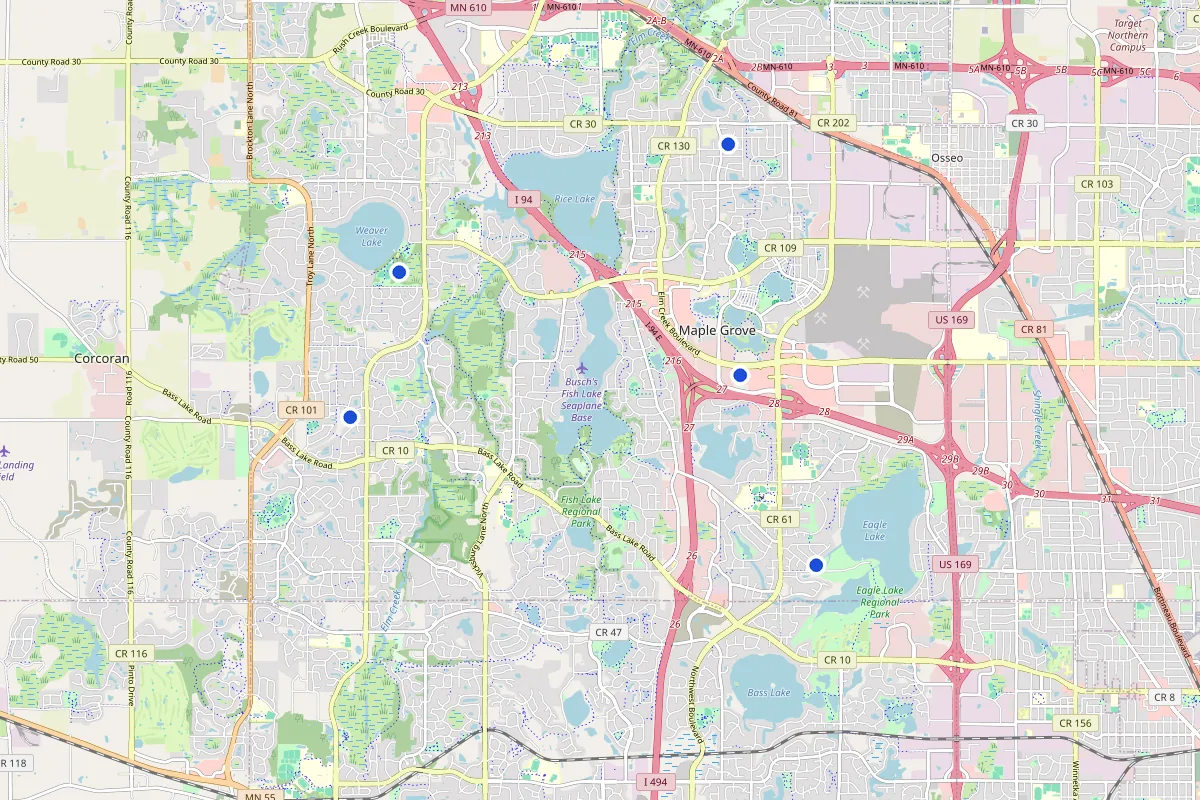
- Weaver Lake — wooded lots north of Bass Lake Road (55311)
- Eagle Lake — Eagle Lake basin and the 93rd Avenue corridor (55369)
- Rush Creek — newer subdivisions with footprints that fit 70-foot builds (55311)
- Elm Creek — corridors off Elm Creek Boulevard (55369 / 55311)
ZIP coverage: 55311 and 55369 — plus adjacent Plymouth, Brooklyn Park, and Osseo on request.
Related services
- Multi-sport court installation in Maple Grove, MN — often paired with batting cages when households want a basketball or pickleball surface alongside the cage
- Backyard basketball court in Maple Grove, MN — common companion build for hitter-athlete households