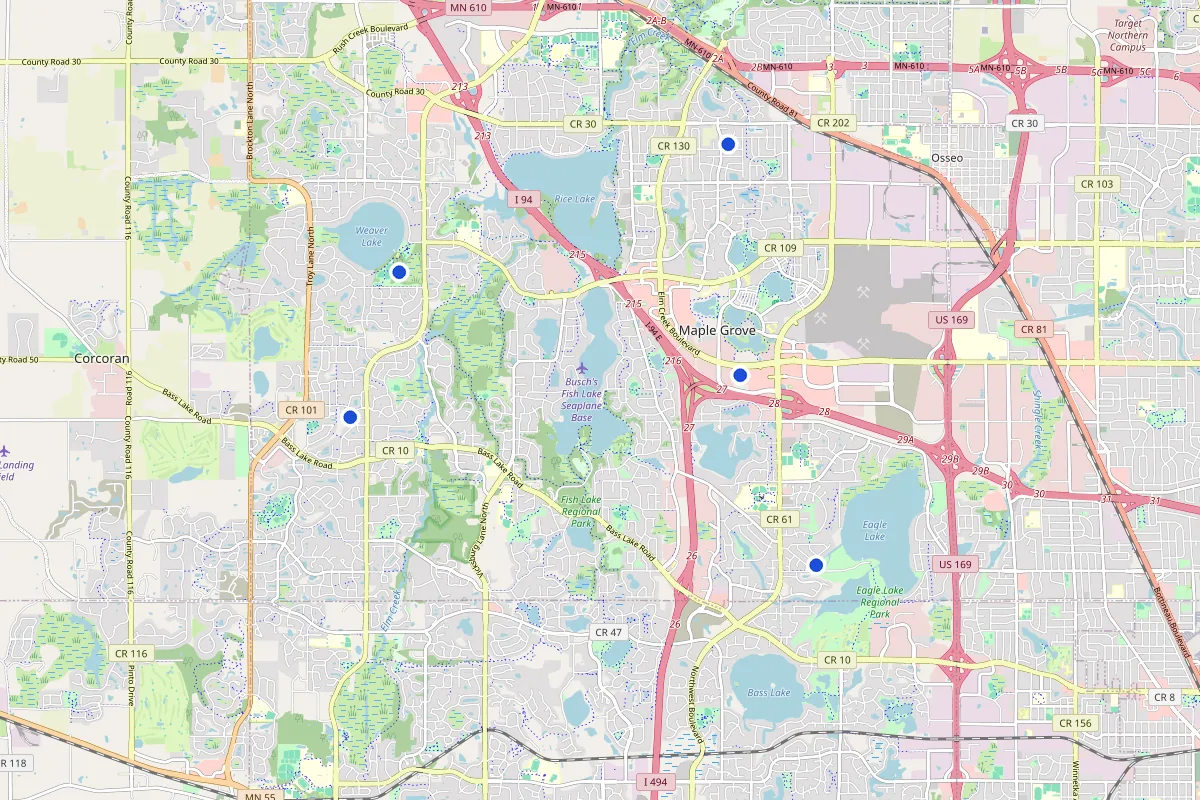
Backyard tennis courts in Maple Grove, MN cover new hard-court builds, tennis-court resurfacing, and pickleball-to-tennis conversions for homeowners across Maple Grove and the northwest Twin Cities metro in Minnesota. A backyard tennis court in Minnesota is a bigger commitment than in warmer states. The footprint is large, the freeze-thaw winters are hard on the surface, and the build window is short. This page covers what a backyard tennis court in Maple Grove actually involves: sizing and lot fit, surface choice, cost, resurfacing, setbacks and HOA review, and the April-through-October Minnesota install season.
What backyard tennis court installation in Maple Grove, Minnesota typically looks like
A regulation tennis court is a large object. The playing surface for doubles is 78 ft × 36 ft, and once you add the run-off space behind the baselines and along the sidelines, a full court needs roughly 60 ft × 120 ft — about 7,200 sq ft of flat, well-drained ground (USA Shade). That footprint is the single biggest planning constraint on a Maple Grove lot, and it’s why the first thing worth settling is whether a full court fits — or whether a half-court, a practice wall, or a combination court is the better build.
Most calls come from three groups: families with junior players who want a dedicated home practice surface, households replacing an aging court that has cracked over successive winters, and homeowners with larger lots — Rush Creek, Elm Creek, and the wooded parcels north of Bass Lake Road — who have the room a full court needs.
This site covers tennis court construction in Minnesota, from design and site work through hard-court paving, surfacing, and resurfacing for permanent backyard courts. Portable nets and roll-out lines on an existing driveway are a different category.
The Maple Grove tennis scene
Tennis is well established in Maple Grove’s public parks. Gleason Fields on 67th Avenue North runs tennis, basketball, and pickleball courts on one complex, and the city maintains dedicated Central Park tennis courts along with tennis courts scattered across its 50-plus parks (per the City of Maple Grove parks pages). A backyard court is the private version of a game residents already play all over town — no waiting for an open court, and a surface set up the way you want it.
When a full court won’t fit: half-court and practice-wall options
Because a full 60×120 ft court rarely fits a standard Maple Grove lot, a large share of Maple Grove backyard tennis projects are not full courts:
- Half-court / hitting court. A single-service-box or half-length layout supports serving practice, drills, and casual rallying on a fraction of the footprint — a common fit for in-town Arbor Lakes and Eagle Lake lots.
- Practice wall / backboard. A solid rebound wall returns the ball for solo practice and needs only a modest paved pad and clearance in front. It’s the smallest-footprint option and pairs well with a driveway or an existing patio.
- Combination court. A hard surface striped for tennis plus pickleball (or basketball) puts more use on the same slab. A standard tennis footprint can hold up to four pickleball courts depending on buffer spacing (VersaCourt), so a combo layout is often the most-used build per dollar.
A site survey maps the buildable envelope, and it is what establishes which of these your lot actually supports before you commit to a design.
Surface choice: hard court vs clay in Minnesota winters
For a Minnesota backyard, the surface decision is largely made for you by the climate. Hard courts — acrylic color-coat over an asphalt or post-tensioned concrete base — are the right choice for MN, and here’s why:
- Clay courts don’t survive MN winters well. Freezing turns the moisture in a clay court to ice, which expands and heaves the surface uneven; thaw leaves it muddy and unplayable, and clay generally has to be shut down, tarped, and babied through winter (LiveAbout). Ice expansion can permanently damage a clay court.
- Hard courts are more freeze-thaw resilient and need far simpler winterization — seal cracks in fall, keep drains clear, and avoid metal snow shovels on the surface.
The trade-off with hard courts is the crack problem. Minnesota’s freeze-thaw cycles are tough on any paved surface: water seeps into a micro-crack, expands about 9% when it freezes, and widens the gap, so a hairline in October can open to a quarter-inch lip by April (Angi). That’s not a reason to avoid a court — it’s the reason surface base quality and a resurfacing schedule matter, both covered below.
How pricing works
Backyard tennis-court pricing spans a wide range depending on whether you’re building new, converting, or resurfacing — and we are not the installer, so we don’t set it. The installer quotes your project in writing after an on-site survey.
What moves the number most: base type (asphalt vs post-tensioned concrete), site prep (a flat, well-drained lot prices lower than one needing retaining walls or drainage rework), fencing height, and whether you add lighting. Ask for the quote in writing and after an on-site survey. Nobody can price a tennis court sight-unseen, and we do not price one at all.
Tennis court resurfacing in Maple Grove
Resurfacing is where most existing-court owners find us. An acrylic hard court needs a fresh color-coat periodically to keep true bounce and traction, and Minnesota’s freeze-thaw winters push that schedule to about every 4–6 years — tighter than the 4–8-year national norm (localtenniscourtresurfacing.com).
Simple upkeep — sweeping, keeping drains clear, and sealing small cracks before winter — pushes you toward the longer end of that range. Heavy play and hard freeze-thaw cycles pull it shorter. If your court has widening cracks or a fading, slick surface, resurfacing on schedule is far cheaper than letting the base fail and needing a full rebuild.
Pickleball, combo courts, and tennis-court conversions
Tennis and pickleball share a footprint, and that overlap runs both directions:
- Pickleball-to-tennis is rarely the move (a pickleball pad is too small for a tennis court), but tennis-to-pickleball conversions are common — a standard tennis court holds two to four pickleball courts, so an underused tennis court can be re-striped and re-netted for pickleball instead of torn out. If that’s your goal, our pickleball court installation page covers it directly.
- Combination courts stripe one hard surface for tennis plus pickleball or basketball. If you’re weighing a single-sport tennis court against a shared surface, our multi-sport court installation page walks through the sport-mix and sizing trade-offs. A dedicated tennis court is the better call when tennis is the primary game and you have the room; a combo court wins when the same slab needs to do more.
Both options are worth raising with the installer before the design is settled, so the surface matches how your household will actually use it.
Maple Grove HOA, setback, fencing, and lighting
A backyard tennis court is a permanent structure, so plan on HOA architectural-review approval in most Maple Grove subdivisions, and on confirming with the City how its zoning setbacks apply to a court on your parcel — that one is a City answer, not ours, and we don’t pull the permit for you. Review boards typically focus on three things: visual impact (fence height, court color, lighting glare toward neighbors), the court’s placement relative to property lines, and drainage. Boards commonly want a scaled layout, the surface and fencing materials, and fencing and lighting drawings; your board will tell you what its packet requires, and the installer who takes the job prepares what they need for it, so you can submit a complete application; what we don’t do is argue the application for you if the board pushes back.
Fencing and lighting are the two features most likely to draw HOA questions. Court-height fencing (8–10 ft vinyl-coated chain-link is standard) keeps balls in but is exactly the visual element boards scrutinize; LED lighting for evening play needs shielded, downward fixtures to avoid spill onto adjacent lots. The survey flags both so they’re in the application from the start, not a change-order later.
Process + lead time
- Site survey. Measure the buildable envelope, check slope and drainage, confirm whether a full court, half-court, or combo layout fits, and flag setback and HOA constraints. Survey scheduling depends on installer crew availability and where you are in the April–October install season.
- Site plan + written estimate. The installer provides a dimensioned plan and an itemized estimate for your review, after the survey and before any build commitment.
- HOA submission (your timeline; typically 2–6 weeks). You submit the package; the installer answers board questions or attends a meeting if requested.
- Build (weather permitting). Excavation, drainage, base, cure, acrylic surface and line painting, fencing, nets, and any lighting.
- Post-install walkthrough with surface care-and-maintenance guidance.
The Minnesota install season runs April through October — frost depth and the temperatures acrylic needs to cure rule out work November through March. Winter is for surveys, HOA documentation, and scheduling the next season’s queue.
The Maple Grove rules that shape a backyard tennis court
A full court is the largest thing most households will ever put in a back yard, so the city code reaches it in ways a patio or a shed never triggers. Three rules do most of the work, and all three are cheaper to read before a design is settled than after.
A court slab counts against a 40 percent impervious surface cap. Maple Grove City Code section 36-787 sets the maximum impervious surface for a lot in the R-1, R-2 and R-3 residential districts at 40 percent. The roughly 7,200 sq ft a full court needs lands on top of the house, the garage, the driveway and any patio already there, so on a standard lot the cap is a real constraint rather than a formality. If a court pushes the lot over it, the fix is a design change: a smaller footprint, a half court, permeable material somewhere else on the property, or a stormwater feature. A builder who measures the lot against the cap before bidding is telling you something useful about how they work. (Source: Maple Grove Code of Ordinances, Chapter 36 Zoning, section 36-787, read 2026-09-11.)
The 6 foot residential fence limit is the one that catches people out. Court fencing is commonly specified at 8 to 10 feet to keep balls in play, and that is taller than the city allows by right. The Maple Grove Building Department’s Fences handout, revision 4/14/2021, states that in residential areas fences no more than 6 feet in height may be erected, while building permits are not required for fences that do not exceed 7 feet. Those are two separate rules doing two separate jobs, and the zoning limit is the one that governs what you may build. The handout notes that fences differing in height may be permitted by conditional use permit, which means an application, a review and a timeline. Ask any bidder whether their fence line assumes a conditional use permit and who is responsible for filing it. (Source: City of Maple Grove Building Department, “Fences,” rev. 4/14/2021, read 2026-09-11.)
Near water the fence rules tighten again. The same handout caps fences inside the 75 foot lakeshore setback area at 5 feet, requires see-through visibility equal to that of a chain link type fence, and requires the material to be treated in browns to greens so it blends with the natural surroundings. It also bars any fence from the triangular sight area on a corner lot. Maple Grove has a great deal of shoreline, so on a lot near Weaver Lake, Eagle Lake, Fish Lake or Rush Creek, a bid that quotes a standard court fence without mentioning the setback has probably not looked. (Same source, read 2026-09-11.)
Sources: Maple Grove Code of Ordinances, Chapter 36 Zoning and the City of Maple Grove Building Department “Fences” handout, rev. 4/14/2021. How each one applies to your specific parcel is a question for Maple Grove Community Development at 763-494-6040, and that call is yours to make rather than ours.
Common questions
How much does a backyard tennis court cost in Maple Grove, MN? Half-courts, practice walls, and combo courts cost meaningfully less. Every quote is written by the installer after an on-site survey.
How much does it cost to resurface a tennis court in the Twin Cities? It depends on court size, the condition of the existing surface, and whether you need isolated crack repair or a full color-coat. Resurfacing an intact court is a much smaller job than repairing a cracked base first. The installer quotes it in writing after looking at the court — we don’t set their pricing.
How often does a tennis court need resurfacing in Minnesota? About every 4–6 years for a Minnesota hard court — tighter than the 4–8-year national average because freeze-thaw cycles are hard on the surface. Sealing cracks and keeping drains clear each fall pushes you toward the longer end.
Clay or hard court for a Minnesota backyard? Hard court. Clay heaves and cracks when the moisture in it freezes, and it has to be tarped and shut down all winter. A hard court is more freeze-thaw resilient and needs only simple winterization (seal cracks, clear drains, no metal shovels).
How much space do I need for a backyard tennis court? A full court with run-off needs about 60 ft × 120 ft (~7,200 sq ft) of flat ground. If your lot can’t fit that, a half-court, a practice wall, or a tennis/pickleball combo court are the usual alternatives — the site survey confirms what fits.
Do I need HOA approval for a backyard tennis court in Maple Grove? Almost certainly. Most subdivisions require architectural-review-board approval, and the city zoning code sets residential setbacks whose application to a court on your specific parcel is a question for the City rather than for us. Your board sets its own submission requirements, and the installer who takes the job prepares what they need for it; you submit and manage the review.
Can you convert my tennis court to pickleball, or build a combo court? Yes — a standard tennis court holds two to four pickleball courts, and combination courts get built striped for tennis plus pickleball or basketball. See our pickleball and multi-sport court pages.
Tennis court builder, tennis court construction, tennis court paving: are these different jobs? These are names for stages of one job rather than three separate trades. Tennis court construction covers the whole sequence, from excavation and drainage through the base, the acrylic color coat, fencing, and line painting. Paving is the base step inside that sequence, the asphalt or post-tensioned concrete slab everything else is built on. A tennis court builder is the contractor who carries out that work. We are not that contractor and we do not build courts. We connect Minnesota homeowners with a local installer who does, and the installer quotes the job in writing after an on-site survey.
Can a court be installed during MN winters? No. Acrylic needs sustained temperatures for a proper cure and concrete pours hit frost-depth issues, so the build season is April through October. Winter is for surveys, HOA documentation, and next-season scheduling.
Maple Grove neighborhoods covered
Tennis court builds and resurfacing are covered across Maple Grove — Arbor Lakes, Weaver Lake, Eagle Lake, Rush Creek (larger lots that fit a full court), and Elm Creek. ZIPs covered: 55311 and 55369. Coverage also reaches adjacent NW-metro cities — Plymouth, Brooklyn Park, and Osseo — for the right project.
Get a Maple Grove tennis court quote.
New builds, resurfacing, and combo courts. The installer surveys the site, quotes in writing, and supports the HOA submission. April–October install scheduling.
Call (763) 575-7899 or scroll to the quote form below.